
PELE AND KAHAWALI
Long ago, during the reign of King Kealiikukii, there lived a chief named Kahawali, the chief of Puna. Kahawali was known for his courage and skill, and he was one of the king's favorite companions.
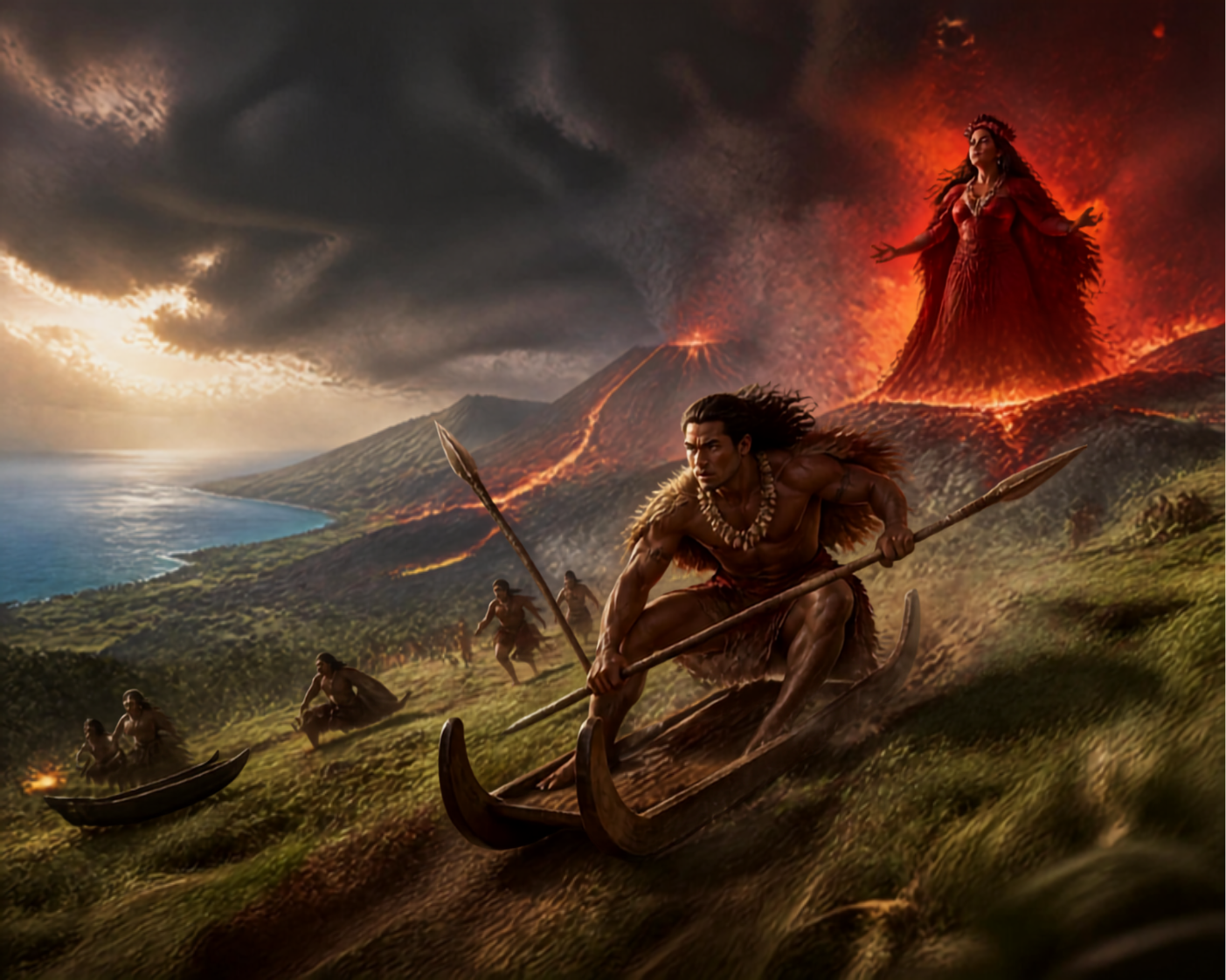
One day, Kahawali and a close friend went to a hillside to enjoy a game of holua, a traditional Hawaiian sled race. The slope was crowded with people who had come to watch.
Musicians played drums, dancers performed, and the entire hillside was filled with laughter and excitement. Kahawali climbed onto his narrow wooden sled, pushed off, and shot down the hillside at incredible speed.
The crowd erupted in cheers.
But Kahawali did not know that someone much more powerful was watching.
High on the volcano of Kīlauea lived Pele, the powerful goddess of fire and volcanoes. When she heard the sounds of celebration, she became curious and came down from the mountain.
Pele appeared as an ordinary woman and stood at the top of the hill, watching Kahawali race.
Then she challenged him.
“Will you race me?”
Kahawali accepted.
The two climbed onto their sleds and prepared to race.
They pushed off together.
Whoosh!
The sleds flew down the slope.
Pele tried to keep her balance, but Kahawali was an expert. He shifted his weight at exactly the right moments, guiding his sled smoothly over the ground.
He reached the bottom first.
The spectators cheered loudly.
Pele had lost.
She climbed back up the hill and looked at Kahawali.
“Give me your sled,” she demanded.
But Kahawali did not realize who she really was. He thought she was simply another woman who wanted to use his sled.
“No,” he replied. “Why should I give it to you?”
Pele's expression changed.
She was furious.
Kahawali climbed onto his sled again, determined to continue the game.
But before he could race down the hill, Pele stamped her foot against the earth.
The ground shook.
An earthquake tore through the hillside.
Kahawali froze.
Then he heard a terrible rumbling coming from the mountain.
Fire appeared.
Lava began pouring down the slope.
And Pele was no longer hiding her true form.
She had revealed herself as the mighty goddess of the volcano.
Kahawali grabbed his broad spear.
“Run!”
He and his friend raced away as the lava flowed behind them.
The musicians, dancers, and spectators scattered in every direction. The peaceful celebration had become a desperate escape.
Kahawali ran toward an area called Puʻukea. There, he threw off his heavy cloak so he could move faster.
He continued toward his home.
Along the way, he saw his favorite pig and stopped for just a moment to greet it. Then he hurried to his mother's house at Kukii.
When he reached her, he warned her about Pele.
“Pele is coming,” he told her. “You must be careful.”
Then he had to leave.
The lava was getting closer.
Soon Kahawali found his wife, Kanakawahine.
She looked at the approaching fire and said, “Stay here with me. If we must die, let us die together.”
But Kahawali shook his head.
“No. I have to keep going.”
He then found his two children, Poupoulu and Kaohe.
He looked at them, knowing he might never see them again.
“I grieve for you,” he said.
Then he forced himself to leave.
The lava continued to follow.
Kahawali and his friend ran until they reached a deep chasm in the ground.
There was no way around it.
Kahawali looked down.
Then he looked at his spear.
He placed it across the gap and carefully walked over it.
He made it safely to the other side.
His friend called after him.
“Help me!”
Kahawali turned around.
Without hesitation, he reached his spear back across the chasm. His friend grabbed it, and Kahawali pulled him safely across.
But there was no time to rest.
Pele was still coming.
The two men ran again.
Eventually, Kahawali reached Kula, where he encountered his sister, Koai.
He barely had time to stop.
“Aloha oe,” he said.
Then he continued running.
At last, Kahawali reached the shore.
His younger brother had just returned from fishing and was preparing to protect his family when Kahawali arrived.
There was no time to explain everything.
Kahawali and his friend jumped into the canoe.
They paddled away from the shore as quickly as they could.
Pele saw them escaping.
In anger, she hurled enormous rocks toward the canoe.
The stones crashed into the ocean around them.
BOOM!
SPLASH!
But somehow, none of them struck the canoe.
Kahawali and his friend kept paddling.
Then something unexpected happened.
A strong east wind, called the kumukahi, began to blow.
Kahawali raised his broad spear upright in the canoe, using it like a mast and sail.
The wind caught it.
The canoe surged forward.
Whoosh!
They sailed farther and farther away from Hawaiʻi.
They reached Maui, where they rested for one night. Then they continued to Lānaʻi, and afterward to Molokaʻi.
Finally, they reached Oʻahu.
There, Kahawali found his father, Kolonohailaau, and his sister Kanewahinekeaho.
At last, he was safe.
He told them everything that had happened—the sled race, the mysterious woman, the anger of Pele, the lava, the desperate journey, and their escape across the ocean.
What had begun as an ordinary day of fun had become a journey for his life.
Kahawali had faced the anger of one of Hawaiʻi's most powerful gods and survived through courage, determination, quick thinking, and his willingness to help the friend who had stayed beside him.
His story became one of the many legends remembered across Hawaiʻi—a story of adventure, danger, family, and the tremendous power of Pele.
Carissa O'Connell
Avid explorer of all things related to Hawaiiana, Polynesian, and Asian culture
Leave a Comment